
How to Deal With Negative People, According to Kevin Trudeau
The practical answer to how to deal with negative people is that you manage your exposure and your own response, because you cannot edit the other person. Kevin Trudeau makes a sharper version of that argument in a Masterclass published on August 26, 2026. His claim is that most people are not dealing with negative people at all. They are quietly absorbing them, then treating the borrowed opinions as their own. He builds the whole talk on one word he credits to the sales trainer Zig Ziglar: SNIOP.
This article covers what that word means, why a single negative person lands harder than several positive ones, and six things you can actually do about it. Every claim Trudeau makes is reported here as his claim.
How to Deal With Negative People: The Short Answer
If you want the compressed version before the detail, here is what the video and the wider evidence point to.
- Admit you are affected. Trudeau puts this first. He argues nobody defends against an influence they insist does not reach them.
- Set the boundary on time, not on the person. Deciding how long you spend is easier to hold than deciding who is allowed to exist.
- Stop taking things personally. A constantly negative person is usually running the same script with everyone.
- Separate the complaint from the complainer. Some complaints contain a real problem worth solving. Most do not need your agreement.
- Interrupt the loop out loud. Trudeau's own version is to say "cancel, cancel" the moment he notices he has picked something up.
- Ask what you actually think. The closing question of his talk, and the one that turns a borrowed opinion back into your own.
None of that requires the other person to change, which is the point. You are not waiting on their perspective to shift, and you are not trying to argue anyone into a positive outlook. Each one is expanded below, with the wording to use and the reflex to avoid.
SNIOP: The Word Zig Ziglar Taught the World
SNIOP is an acronym. It stands for a person who is Susceptible to the Negative Influence of Other People. Ziglar Inc, the company run by his family, publishes the term in exactly that form and credits it to Zig Ziglar, the American author and motivational speaker who wrote See You at the Top in 1975. Trudeau uses the same expansion, and he introduces it about a minute into the video as the word that reframes the entire problem.
The reason the acronym is useful is that it moves the question. "How do I deal with negative people" puts the work on the other person's behavior. "Am I a SNIOP" puts it on your own permeability. The second question is the one you can act on today, because you own both variables in it.
What Trudeau adds to Ziglar's version
Ziglar's framing was mostly about the people physically around you: the co worker who narrates every problem, the family member with a bad attitude, the friend who treats your good news as naive. Trudeau extends it to the machinery. His claim is that other people, media and recommendation algorithms now shape what you spend, what you believe and what you decide, and that they do it continuously rather than in the single conversations you would notice. Whether you accept that extension or not, it is his central argument in the talk.
He is careful about one thing that gets lost in most versions of this advice. Being susceptible is not a character defect. It is the default setting. The people who handle negativity well are not immune to it. They noticed it first.

Why One Negative Person Outweighs Ten Positive Ones
There is a measured reason a single negative voice sticks. Negativity bias is defined as a cognitive bias in which human cognition is relatively more affected by a negative affect than an equally potent positive affect. Put plainly: a bad thing and a good thing of the same size do not weigh the same to you. The bad one wins on attention, on memory, and on how you judge the person attached to it.
Trudeau reaches for two everyday examples of the same effect. The first is the one bad review. A business collects a long run of positive feedback and one person writes something harsh, and the harsh one is what the next reader remembers and what the owner thinks about at night. The second is the traffic jam that forms on the clear side of the road because drivers slow down to look at something bad on the other side. Nobody organizes that. It is the bias operating at scale, in real time, with strangers.
He also argues that negativity gathers a crowd. A complaint gets agreement faster than a compliment gets it, so the negative reading of any situation tends to arrive with social proof already attached. That is worth knowing before you decide whether a room's mood is a verdict on reality or just the loudest emotional response in it.
How suggestible people actually are
One stretch of the talk is spent on suggestibility. Trudeau points at stage hypnosis and at the mentalist Kreskin as demonstrations that ordinary people accept a suggested reality far more readily than they would predict of themselves. His point is not that you are weak. It is that the gap between how suggestible you think you are and how suggestible you are is the exact space negativity moves in.
What Constant Negativity Actually Costs You
The cost is easy to underestimate because it never arrives as one bill. A negative person does not take a day of your life away in a single afternoon. They take ten minutes of your energy here, a bit of your hope for a project there, and the compounding is invisible until you look back at a year and cannot account for where the ambition went.
Three costs show up most often. The first is decision drag: you stop putting ideas forward, because you already know how the conversation will go and you would rather not spend the emotional energy. The second is a narrowed sense of the future, since it is genuinely hard to plan for a world you have been told repeatedly will not cooperate. The third is the plain waste of time, because a conversation that exists only to circle a problem takes exactly as long as one that solves it.
What makes those bad things stick is that none of them feel like an outside influence while they are happening. They feel like realism. That is the whole difficulty: absorbed negativity does not announce itself as somebody else's opinion, it presents itself as your own mature read on reality. Your well being and your own happiness are affected long before you would think to blame a specific person for it.
Trudeau's version of this cost is broader than the personal one. He argues the same mechanism runs at the level of what you buy and what you believe about your own future, and that the constant exposure is the point rather than any single message. Read that as his claim. The narrower version, that a few negative opinions can quietly redirect a life, is hard to argue with once you have watched it happen.
Step One: Admit You're Susceptible
This is the hinge of the video, and Trudeau spends longer here than anywhere else. His argument is that the person who says "other people's opinions do not affect me" is the most exposed person in the room, because a defense you have declared unnecessary is a defense you never built.
The self test he implies is straightforward. Think of a decision you talked yourself out of. Now ask whose voice was in the room when you did it. Not who was physically present. Whose voice. If a specific person's tone comes back to you before your own reasoning does, you have found where the influence entered. That is not a diagnosis of anything. It is a location. Most people are surprised by how fast the answer arrives once they let themselves ask, and by how often the same voice turns up across unrelated parts of their own life.
What makes this step do real work is that it is not about blame. Trudeau is not asking you to decide the other person acted badly. Plenty of negative opinions arrive from people who love you and think they are protecting you. The question is only whether the opinion is now sitting in your head with your name on it. Plenty of bad advice is delivered by people who mean well and would be hurt to learn how it landed.

An Example of How a Borrowed Opinion Lands
Here is the shape it usually takes. Say you tell a friend about something you want to try. They do not attack it. They say "are you sure that's a good idea right now?" and then talk about someone they knew who tried something similar and it went badly. You leave the conversation feeling flat and slightly sad, and you cannot point to anything unkind that was said, because nothing unkind was said.
Six weeks later you have not started. If you talk it through honestly you realize you are not saying "my friend thinks this is a bad idea." You are saying "the timing isn't right." The opinion has changed owner. That is the handover, and it is the reason this is hard to catch: by the time it costs you something, it does not feel like an outside opinion at all. It feels like your own good judgment.
Notice that nobody in this example is a villain. The friend was worried and said so, which is what friends do. Their behavior was not the problem. The problem was that the opinion crossed over without being examined, and once you can see that clearly you can respond to it without needing to decide the friend was acting badly or that you should have fewer friends.
This is also where the difference between a negative person and one negative conversation matters. A single cautious remark from someone who is usually behind you is worth weighing. The same remark from someone who says it about everything is a pattern, and patterns carry almost no information about the specific thing you asked about.
Six Ways to Deal With Negative People Without Cutting Everyone Off
Most advice on this topic ends at "remove negative people from your life." That is a real option and sometimes the correct one, but it is useless for the cases that actually hurt: a parent, a spouse's sibling, the person two desks away. These six moves are built to work while the person is still in your life.
1. Set the boundary on time, not on the person
Deciding "I will not let this person get to me" gives you nothing to do. Deciding "I give this twenty minutes and then I have something at seven" gives you an exit that does not require a confrontation or a verdict on their character. Setting boundaries around duration and frequency is enforceable, and it does not ask you to spend time auditing whether their behavior crossed a line today.
This also handles the hardest version of the problem, which is a person you cannot remove. You are not deciding whether they are a negative person. You are deciding how much of your week is exposed to them.
2. Stop taking things personally
A person who is negative about your plan was usually negative about the last three plans, including the ones that had nothing to do with you. Treating their reaction as data about your idea is a mistake of attribution. Their response is mostly a fact about them, and about the mood and fear they brought into the room, rather than about the thing you described.
The practical form of this is to ask what they said about the last opportunity someone brought them. If the answer is the same shape, you are hearing a pattern rather than a review. Nothing personal happened, however personal it felt. That realization is usually the point at which people stop rehearsing the conversation afterwards.
3. Separate the complaint from the complainer
Not every negative statement is negativity. Sometimes a person is pointing at a genuine problem and you would rather hear it now than later. The distinction that holds up is whether the complaint comes attached to problem solving. A person who names a risk and then talks about what to do is being useful. A person who names a risk, then a second risk, then a third, and resists every response, is not looking for a solution.
Once you can tell those apart you can accept the first without absorbing the second, which is more precise than deciding somebody is a negative person and discounting everything they ever say. Some of the best advice you will get in your life arrives in a complaint.
4. Answer with a question, not a counter-argument
Arguing with constant negativity feeds it. You supply energy and the other person supplies more material, and the conversation grows. A question does the opposite. "What would have to be true for this to work?" moves the burden without a fight, and it politely ends the loop when there is no answer.
It also protects the relationship. You have not told anyone they are wrong or difficult. You have asked them to do the work of their own claim, and most of the time the complaint runs out of road on its own. It is also a calmer way to respond when you can feel your own temper rising.
5. Interrupt the loop out loud
This is Trudeau's own move, and it is deliberately small. When he notices he has picked up somebody else's negative thought, he says "cancel, cancel." That is all it is. He is not claiming a mechanism. He is using a spoken interruption to mark the moment a thought arrived from outside, before it settles in and starts sounding like his own conclusion. The example he gives is a thought that arrives in someone else's voice and leaves in yours.
Use any phrase you like. The working part is not the words, it is catching the handover in the second it happens rather than discovering it a week later, when the borrowed opinion has already talked you out of something.
6. Ask what you actually think
The talk closes on a single question: what do you think? Trudeau's argument is that most people cannot answer it quickly about the things that matter most, because the answer they reach for was installed by somebody else and never examined.
Asked honestly, it is the whole method in one line. It does not ask you to be positive, and it does not ask you to argue anybody down. It asks you to check the ownership of the opinion you are about to act on. Ask it about your work, your future and the people you spend time with, and the answers tend to differ more than you would expect.
Negative People, Difficult People, and Someone Having a Bad Day
Three different situations get filed under the same label, and the responses that work are not the same, so it is worth telling them apart before you decide anything.
Someone having a bad day is a temporary state. The tell is that it is out of character and it is attached to a cause. Here the correct response is patience and, if you have it, emotional support, because nothing about the person needs managing. Treating a bad day as evidence of a negative person is how you lose good friends over a rough week.
Negative or difficult people are a longer pattern, and even here the two words point at different things. A difficult person is hard to work with: rigid, combative, slow to agree. A negative person may be perfectly easy to work with and still leave every room a little heavier than they found it. The first is about behavior in a task. The second is about the mood that trails behind them. You can often solve the first with a process. The second needs a boundary.
The last case is the person whose negativity is chronic and unchanging. What matters here is accepting that a different perspective is not on offer. Most of the frustration people feel in these relationships comes from continuing to expect a change that the last five years have already answered. Once you stop expecting it, the same conversations cost far less, because you are no longer disappointed by them.
What to Actually Say: Four Responses That Work
Most people know they should respond differently and freeze anyway, because in the moment nothing comes to mind except agreeing or arguing. It helps to have a few lines ready. None of these are clever, and that is deliberate: a line that sounds like a technique invites a fight.
| When they say | The reflex that backfires | Try instead |
|---|---|---|
| "That will never work." | "Yes it will, because..." | "What would have to be true for it to work?" |
| A long complaint with no ask | Matching it with your own | "That sounds frustrating. Are you looking to fix it or to vent? Either is fine." |
| "You've changed." | Defending the change | "Probably. How do you mean?" |
| Constant negativity about a third person | Agreeing to keep the peace | "I don't really have a read on that one." |
The second one does more work than it looks. Asking whether someone wants a fix or a vent is not a trick, it is a real question, and people answer it honestly. It converts an open-ended complaint into a request you can actually meet, and it gives you a clean way to stop offering solutions to a person who did not want any.
The fourth is the one people find hardest, because declining to agree feels rude. It is not. You are not contradicting anyone. You are declining to add your name to a judgment you did not form, which is precisely the handover this whole article is about. Say it lightly and the conversation moves on.
What none of these require is a talk about the relationship. That conversation is occasionally necessary, but it is a much bigger move than most situations need, and people avoid it for so long that the small responses never get used either.
Don't Let Them Put Rats in Your Head
The blunt line arrives near the end of the video, and it is the piece people repeat afterwards. Trudeau's framing is that a negative opinion left unexamined does not sit still. It nests. It shows up as hesitation months later, in a situation the original speaker knows nothing about and has long forgotten.
This is why the earlier steps matter more than they look. The cost of absorbing somebody's negativity is almost never paid in the conversation itself. It is paid later, in an opportunity you decline for reasons you experience as your own good judgment. That delay is exactly what makes the influence hard to spot and easy to underestimate.
His practical instruction is unglamorous: notice the handover, name it, and refuse it in the moment. Rats do not get evicted later. They get kept out. The whole point of naming a negative situation as it happens is that removing it afterwards is far harder than declining it once.

Why "Just Stay Positive" Backfires
The standard advice is to keep a positive mindset and let it bounce off. As a description of the goal that is fine. As an instruction it fails, for two reasons worth naming.
The first is that it asks you to suppress rather than to notice. If your rule is that negative emotions are a failure of attitude, then the moment somebody's remark lands you have two problems: the remark, and the fact that you feel bad about feeling bad. Positive thinking used that way turns an ordinary reaction into evidence against yourself, and people who take it seriously often end up more affected, not less.
The second is that it aims at the wrong target. Positivity is an outcome. Nobody can execute it directly, in the same way nobody can execute "be taller." What you can execute is a boundary on time, a question instead of an argument, and a decision about whose read you are going to trust on a specific matter. Do those and a better mood follows. Chase the mood on its own and there is nothing to actually do, which is why the advice feels useless exactly when it is most needed.
There is a third thing that gets missed. Some negative feelings are accurate. Fear of a genuinely risky plan is information. Being hurt by someone who was unkind makes sense. A framework that treats every negative emotion as an intruder to be removed will eventually talk you out of a signal you needed, and the people who have most thoroughly learned to stay positive are sometimes the worst at hearing bad news that is true.
Trudeau's version avoids that trap, whatever else you make of his wider claims. He is not asking anyone to feel good. He is asking whose thought it is, which you can answer while feeling perfectly terrible.
When the Negative Person Is You
It is worth turning the question around, since almost everyone is somebody else's difficult conversation occasionally, and this is the one case where you can change the person directly.
The honest test is not whether you have negative thoughts. Everyone does, and treating that as a fault is a good way to damage your self esteem for no gain. The test is what happens to other people's ideas when they reach you. If your reliable first move is to name what will go wrong, and you notice that people have started giving you news rather than plans, that is worth knowing about.
Your own negativity also tends to be the most protected from examination, because from the inside it does not feel like negativity at all. It feels like being the only person in the room paying attention to the risk. Sometimes that is exactly what it is, and the room needs it. The distinction is the same one that applies to everybody else: does the objection come with an interest in problem solving, or does it just need to be said?
Trudeau's step one applies here with more force, not less. Admitting you are susceptible and admitting you are transmitting are the same admission viewed from two sides, and neither costs anything except the pretence that you are the one person in your life whose perspective arrived entirely from within.
Dealing With a Chronically Negative Family Member or Co Worker
The general advice breaks down in the two situations people actually search for, so they are worth taking separately.
At home, with a family member
You cannot apply distance here, and trying to usually makes things worse. What works better is changing the format rather than the frequency. A negative conversation that happens on a walk, or over a task with something to do in it, has less room to spiral than the same conversation across a table with nothing else happening.
Lower the target too. You are not trying to convert a family member into a positive person. You are trying to stop one bad day from setting the tone for the household, which is a smaller and far more achievable goal. Setting boundaries inside a family works better when they are about the shape of the day than about the person.
At work, with a co worker
Work has a structural advantage: there is a legitimate reason to end any conversation, and nobody needs an emotional justification to use it. Keep exchanges short and specific, move anything that matters into writing, and let the constant negativity happen without an audience. Complaints that get no engagement tend to fall on deaf ears and stop being aimed at you.
Where it affects the work rather than just the mood, treat it as a work problem with a work process, not as a personality you have to fix. Nobody at work is obliged to absorb another person's negative energy to be considered a good colleague.
Rebuilding the Positive Side
Reducing exposure is only half the job. Removing a negative influence from a week leaves a gap, and if nothing fills it the gap tends to be filled by whatever is loudest, which is rarely an improvement.
The useful move is to spend time deliberately with positive people rather than waiting for it to happen. That does not mean people who are relentlessly upbeat, and it definitely does not mean people who are unwilling to hear that something is wrong. It means people whose first response to a plan is a question about the plan. A positive outlook that cannot survive contact with a real problem is not much use to anybody, and it makes for poor advice.
Making new friends as an adult is slow, so the more practical version is usually to reweight the ones you have. Most people already know two or three whose reaction they instinctively trust and several whose reaction they brace for. Sending the important news to the first group first is a small change that does more than any amount of positive thinking practiced alone.
It is also worth being specific about what you are asking for. "Tell me what you think" and "I have decided, I just want someone in my corner today" are different requests, and good friends will answer either one accurately if you say which it is. A great deal of accidental negativity is really a mismatch between the two, where someone gives careful criticism to a person who needed encouragement and both walk away feeling bad.
Where SNIOP Sits in Kevin Trudeau's Wider Teaching
This video is one piece of a larger argument he has made across several talks, and it connects in a few places worth following.
The clearest neighbor is his teachability index, which measures willingness to learn against willingness to change. A SNIOP scores badly on the second axis for a reason that has nothing to do with stubbornness: the opinions blocking the change are not theirs. It also sits next to what he calls counter intentions, the inherited beliefs that quietly run against a stated goal, since an absorbed negative opinion is a counter intention with a known author.
Two other pieces are adjacent. His attractor field material makes the same argument about physical environment that this video makes about social environment. And his account of why manifesting isn't working for most people ends up in a similar place, since a borrowed belief is hard to act against no matter how well you run the rest of the process.
For Ziglar's original, our See You at the Top book review covers the six steps in order. His broader claims about how influence is organized appear in the secret society material, and the full book list gives the wider context. His own book on the subject sits at Your Wish Is Your Command.
What the Masterclass Covers, Chapter by Chapter
The video is chaptered, and the official time codes make it easy to use as a reference rather than a single sitting. The chapter names below are the ones on the official upload.
- 0:00 This Isn't Your Life. The opening claim, that the life most people are living was assembled from other people's expectations.
- 0:37 People Control What You Think, Say & Do
- 1:07 SNIOP: The Word Zig Ziglar Taught The World. The definition, and the best place to start if you only watch one section.
- 1:58 How The Media Programs Your Beliefs
- 2:57 The Real Definition Of Financial Success
- 4:17 What The Brotherhood Knew About Manipulation
- 4:40 The Amazing Kreskin
- 6:39 How Suggestible Are People? Ask A Hypnotist. His argument that people underestimate how readily they accept a suggested perspective.
- 7:09 One Bad Review Changes Everything
- 7:57 The Gawker's Traffic Jam
- 8:43 The Negativity Feeding Frenzy. These three run together and make the negativity bias case with everyday examples.
- 9:32 How The Uncontrollable Live
- 11:24 Step One: Admit You're Susceptible. The longest and most practical stretch of the talk.
- 13:22 When Did They Get In Your Head?
- 14:21 Two Men, One Opportunity
- 15:57 Same Room. Different Future.
- 16:49 Cancel. Cancel. The interrupt he uses on himself.
- 17:23 Don't Let Them Put Rats In Your Head
- 18:07 What Do YOU Think? The closing question.
If you are short on time, 1:07, 11:24 and 18:07 carry the argument on their own: what the word means, what to admit, and what to ask yourself afterwards.
Watch: Your Thoughts Aren’t Yours - And You Don’t Even Know It
The full Masterclass runs 19 minutes and is chaptered, so you can jump straight to the SNIOP definition at 1:07, the "admit you're susceptible" section at 11:24, or the rats line at 17:23.
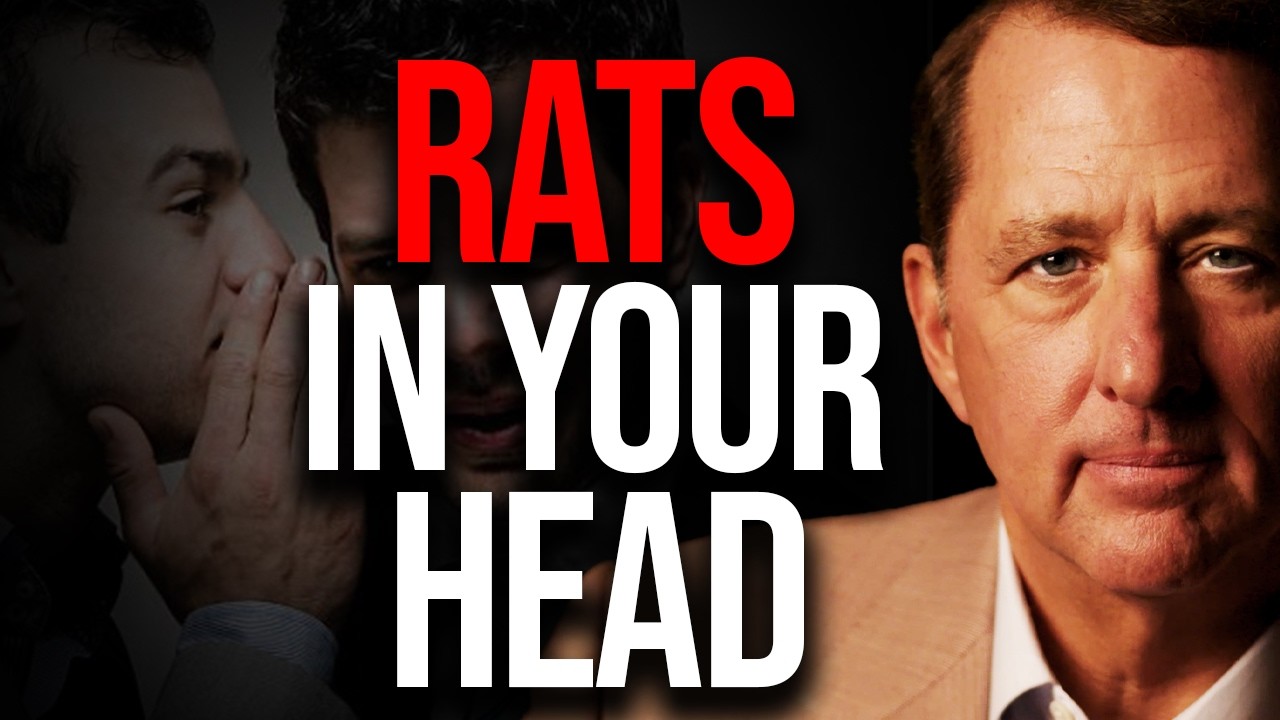
The other half of the question is which voices deserve a hearing in the first place, which is where Trudeau and Dylan Gemelli start in who you should listen to about money.
Frequently Asked Questions
How do I shut down a negative person?
Ending the exchange works better than winning it. Ask one question that puts the burden back on the claim, such as what would have to be true for it to work, and then close the conversation on time rather than on agreement. Arguing supplies energy and the other person supplies more material, so a counter-argument usually extends the loop you are trying to end. You are not looking for the last word. You are looking for the last minute.
Why are some people constantly negative?
Often it is habit rather than intent. A negative reading of a situation gets agreement faster than a positive one, so it is socially rewarded and gets repeated until it becomes the default lens. Some of it is also protective: people who expect the worst are rarely disappointed, and for a person who has been burned that trade can feel like good sense. Trudeau's own answer is that much of it was absorbed from somewhere else and never examined, which is the argument the whole Masterclass rests on.
What does SNIOP mean?
SNIOP stands for a person who is Susceptible to the Negative Influence of Other People. Ziglar Inc credits the term to Zig Ziglar, the author and motivational speaker who wrote See You at the Top in 1975. Kevin Trudeau uses the same expansion and builds his Masterclass around it, arguing that the useful question is not whether other people are negative but whether their negativity is reaching you.
How do you change a negative mindset?
Start by finding out which parts of it are yours. Trudeau's step one is admitting you are susceptible, and the check he implies is to take a decision you talked yourself out of and identify whose voice was in the room when you did it. Opinions you can trace to a specific person are the ones most open to change, because you can evaluate them as somebody else's position rather than as a fact about you. That is a smaller job than trying to become a positive person by force.
Why do negative thoughts keep coming into your mind?
Partly because your cognition is built that way. Negativity bias is the finding that human cognition is relatively more affected by a negative affect than an equally potent positive affect, so negative material wins on attention and on memory against positive material of the same intensity. That is a general cognitive tendency, not a verdict on you, and it means a recurring negative thought is often just the one that was easiest to encode rather than the one most likely to be true.
What are the signs of a negative person?
The pattern is more telling than any single remark. Watch for a response that stays the same shape regardless of what is proposed, resistance to every solution offered rather than to a particular one, and complaints that arrive without any interest in problem solving. A person who names a real risk and then discusses what to do about it is being useful, not negative, and collapsing those two together is the most common mistake people make here.
How do you deal with negative people at work?
Use the structure the workplace already gives you. Keep exchanges short and specific, move anything that matters into writing, and end conversations for ordinary reasons that need no emotional justification. Constant negativity that gets no engagement tends to fall on deaf ears and stops being aimed at you. Where it affects the work itself rather than the mood, handle it as a work problem with a process, not as a personality you are responsible for repairing.
How do you deal with a negative family member you cannot avoid?
Change the format instead of the frequency. The same conversation on a walk, or alongside a task, has less room to spiral than one held across a table with nothing else going on. Lower the target as well: you are not trying to turn a family member into a positive person, only to stop one bad day from setting the tone for everyone else. That is smaller, and unlike the first goal it is achievable.
How to Deal With Negative People: The Short Version
Kevin Trudeau's answer to how to deal with negative people is that you are asking about the wrong person. The variable you control is your own permeability, and his first instruction is to admit it exists at all. The word he uses for the failure, SNIOP, is Zig Ziglar's, and Ziglar Inc still publishes it in the same form: susceptible to the negative influence of other people.
The parts of this that hold up independently are worth separating from the parts that are his. Negativity bias is a documented cognitive tendency, and it explains the one bad review and the traffic jam without needing any further theory. The wider claim about media and algorithms shaping what you think is his argument, presented here as his. Both point at the same practical move: notice the handover when it happens, and ask what you actually think before you act on an opinion you did not write.
More of his work is at kevintrudeau.com.